
Frac Tank & Frac Liners
Posted in Specialty Products
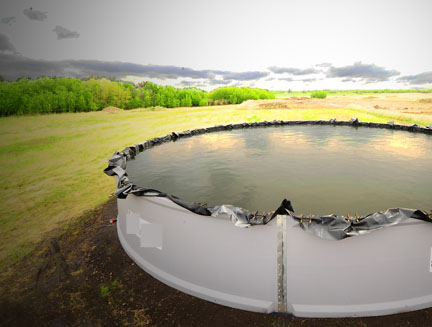
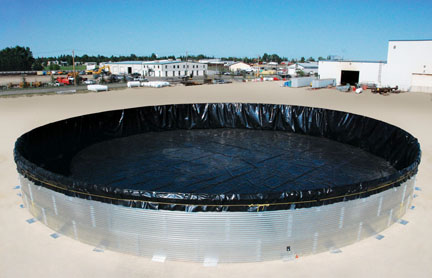
TerraMarine Geo Products manufactures and fabricates liners for all types of Frac Tank Systems, which are Above Ground Liquid Storage Impoundments used to hold large volumes of frac water and flow-back and formation water in hydraulic fracturing operations. Flow-back and formation water coming to the surface must be captured and stored until treated and reused or transported to a disposal or facility. Liquid storage near the well head has traditionally been accomplished with inground impoundments or batteries of small (400-500 barrel) tanks manifolded together. More recently, extremely efficient, high capacity (10,000 to 60,000+ barrel), above-ground impoundments have been introduced. This article highlights the benefits of these systems and provides guidance regarding their selection and use.
BENEFITS OF ABOVE GROUND STORAGE TANKS
I. Benefits of Frac Tanks versus in-ground pits, ponds or impoundments:
- Are Safer for Workers and Wildlife: These systems are highly visible such that worker and vehicle fall hazards as well as wildlife entrapment are reduced. Also, the defined structure and shape allows them to be fitted with pre-designed, re-usable netting or floating covers design to protect flying wildlife as well as prevent evaporation, provide insulation and/or collect gases.
- Require Less Ground Disturbance: Above-ground impoundments only require that the surface to be generally level and free of debris, large stones, etc. Other than for site leveling, they do not require extensive excavation, blasting or dewatering. Reclamation is also more efficient. The impoundment and liner are simply disassembled and hauled away. Leaving a clean, firm surface that is immediately usable by the surface owner.
- Are More Durable and Less Prone to Leakage: In most above-ground impoundments, a steel wall provides protection to the liner component reducing the risk of operational damage. In-ground ponds are also lined. However, these liners are at and below grade and thereby prone damage from contact with vehicles, workers, tools, and wildlife.
- Are Easily Leak Monitored & Fitted with Secondary Containment: Any leakage from an above-ground system is readily detectable and can be monitored/repaired more easily than in below grade systems. In addition, they can be constructed directly within secondary containment and/or above leak detection systems without expensive and unreliable underground sumps, pumps, and sensors.
- Are Mobile and Reusable: Most large, above-ground systems are easily de-constructed, transported and stored or reconstructed on another site. Only the liner component (a fraction of the overall cost) must be replaced each time the system is moved. This leads to significant cost savings over the useful life of the structure.
- Are Faster to Install and Remove: In many cases, 20,000 to 40,000+ barrels of storage may be installed and ready for use within one to three days of mobilization using large above-ground systems. Demolition and removal requires about two-thirds of the install time.
- Are Subject to Better Quality Control: A reputable above-ground system has been engineered to safely hold the liquid within. In addition, the liner component is prefabricated in controlled, factory environment and delivered to the project site in a single, leak-free panel. Most below ground impoundments are simply scraped out without proper regard for slope or embankment stability and fitted with liners that are field-seamed in less than optimal conditions.
II. Benefits of Frac Tanks Vs batteries of small tanks:
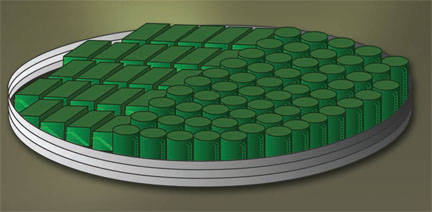
- Significantly Reduce Truck Traffic, Site Congestion and Footprint Required. One 40,000 barrel above-ground impoundment can be transported on two to three trucks. This significantly reduces road damage, public nuisance and site congestion. The same storage volume would require transporting, staging and manifolding 80 individual 500 barrel tanks plus support vehicles. In addition, the overall footprint required for high capacity, above-ground storage is 30 to 50 percent less than that of an equivalent small tank battery. These considerations are particularly important in the Marcellus Region where roads are narrow and windy, lease sites are small and the topography is rolling.
- Are Faster to Install and Remove: As stated earlier, 20,000 to 40,000+ barrels of storage may be installed and ready for use within one to three days of mobilization using a large volume, above-ground system. The logistical problems associated with additional truck movement, staging and man folding smaller tank batteries leads to longer set-up and removal times.
- Allow Larger Volumes of On Site Storage: The versatility and efficiency of high capacity, above-ground systems gives the operator the ability to add on-site storage volume. This decreases the risk of water shortages during critical stages of the completion process. The systems also provide cost-effective storage capacity for treatment of flow-back water in closed loop systems.
- Are More Efficient and Lower Cost: Whether the system is rented or owned, the efficiency provided by large-volume, above-ground impoundments is impressive. The overall operational cost of these systems is generally about one-half that of small tank batteries.
GUIDANCE FOR SELECTING THE RIGHT SYSTEM
As with any new technology, there are some points of caution associated with large volume, aboveground impoundments. Improper system design, construction, lining or operation can lead rapid loss of the contained liquid. Considering that a single impoundment can hold more than 2.5 million gallons of water, this is not something to take lightly. The following recommendations and points of caution have been developed to assist in consideration of the technology.
Shape: Most large above-ground impoundments are circular in footprint. This configuration is favored because the outward stresses generated by the stored liquid are efficiently and uniformly transferred to the walls as “hoop tension.” Therefore, walls are self-supporting and do not require extensive bracing or slope. This provides a firm, uniform surface to support and protect the containment liner. Square, rectangular and odd-shaped systems are also available and can
maximize usable storage footprint. However, these systems require special engineering attention.
Without the benefit of hoop stress, the outward force and concentrated corner stress generated by stored liquids must be resisted by external wall bracing. Although any above-ground impoundment should be visually barricaded to avoid vehicle and equipment impact, systems requiring extensive bracing are particularly vulnerable to damage. Significant damage to even a single brace could lead to total breach of the impoundment.
System Dimensions: A virtually endless variety of footprint sizes and heights are available. Most commonly used systems are between 75 and 250 feet in diameter and seven to 15 feet in height. Increasing wall height allows for additional liquid storage in a given footprint. Therefore, higher walls are favorable. However, wall stress in both round and other shaped systems is a direct function of the depth of liquid being stored (stress is also a function of diameter in round tanks). It is important to ensure that the all system components are designed to safely carry the depth of liquid held within and that any depth limitations provided by the system supplier are not exceeded.
Structural Components: In these systems, loads are carried by the ground beneath and the side walls. It is not recommended that the liner be used to carry load. The increased risk of damage to the unsupported liner and potential loss of containment is too great. The ground beneath the system should be firm and non-yielding. If installed above frozen or soft ground, the area should be improved using geosynthetic materials (geogrids/geocells and stone), crane mats or other means.
The walls of an above-ground impoundment must be designed to contain the liquid within under all relevant loading scenarios (wind, earthquake, vehicle/equipment impact, etc.) plus a reasonable factor of safety (normally 2.5+). The system must be designed by a qualified engineer. Site specific design is not necessarily required with an above-ground impoundment provided that the system is operated within its established limits. Before buying, renting or using any impoundment system, it is important to request verification that the system has been properly engineered. Installation and operational instructions/limitations should also be requested and followed.
GEOMEMBRANE LINER SYSTEM:
The geomembrane liner is critical to the success of any impoundment system. It is important to follow TMG’s recommendations and best practices during installation. In particular, the ground under the system should be relatively smooth and free of sharp debris, large stones, or any other objects that may damage the liner. If this is not possible, a layer of sand, crane mats or geocomposite drainage material may be used to help smooth the ground surface. It is also recommended that at heavy (10 to 16+ oz/sy) nonwoven geotextile cushion be placed on the ground before the liner is
installed.
To line above ground impoundment systems it is recommended to use a geomembrane with good chemical resistance and flexibility to resist bridging, tearing and puncture such as 30 or 40 mil thickness Dakota or Predator Series. We can also supply white on one side for easy visual identification.
The following are the some of the advantages of specifying Dakota and Predator series for above ground impoundment systems.
- Factory fabricated and delivered in a single panel.
- Certified leak free upon delivery, with complete quality control documentation available.
- Rolled, folded, and packaged such that the liner can be stored and handled without damage and installed from the center of the system without flipping panels or extensive dragging along the ground.
- Accompanied by installation, operational and repair instructions as well as inspection checklists.
- Capable of high elongation and fatigue cycles without puncture or tear. High strength/low elongation such as scrim reinforced or HDPE are NOT recommended for most aboveground systems as they tend to bridge over voids and ground debris leading to stress concentration, punctures, tearing and leakage.
- Resistant to degradation under exposure to UV light, brine and hydrocarbons and other chemicals associated with well head operations.