
Geogrids
Posted in GeoSynthetics
We have a range of geogrids available to suit all soil reinforcement applications. Geogrids are available from stock in most TMG locations and most types of geogrids can be purchased by special order. TMG also provides design services for soil reinforcement applications where we can provide preliminary designs on suitable projects.
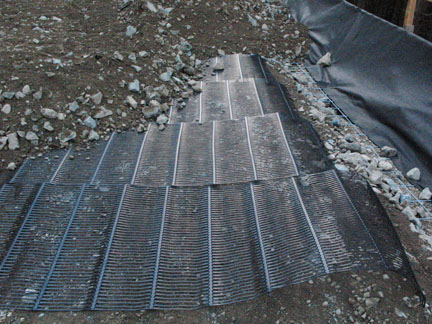
There are many types of geogrid available on the market and there are patent restrictions in a few areas. Geogrids are open structures composed of pre-stressed, high strength bars, with excellent long term creep strengths. There are a number of different types of geogrids. Polyester (PET) type geogrids are made from a woven matrix of high tenacity polyester fibres that are coated with a protective polymer coating. The polyester fibres are oriented in one principle strength direction.
Geogrid strengths can be very high, with design values of up to possible 13,500 lbs per ft. The strength of a geogrid allows positive reinforcement of embankments, steep slopes, retaining walls and other vertical soil structures. Geogrids interlock with the soil providing long term reinforcement and are the most cost effective method of creating additional horizontal space. Polyester geogrids have extremely good long term creep performance.
Biaxial polyester geogrids are used in base reinforcement applications such as roads, storage yards and parking lots or any other load bearing structure. Biaxial polyester geogrids provide good tensile strength in both principle directions. Biaxial polyester geogrids increase the service life of pavement structures by confining the base course by preventing the lateral spreading of the base or sub-base aggregate and allows for shear interaction to develop between the aggregate and the geogrid. Biaxial polyester geogrids also increase the tensile strength of the aggregate by reducing the applied
vertical pressure of heavy loads at depth of aggregate by spreading loads over a wider area. One layer or multi–layer biaxial polyester geogrid construction distributes loading and disperses stress more effectively. Biaxial polyester geogrids are inert to biological degradation and are resistant to naturally encountered chemicals, alkalis and acids.